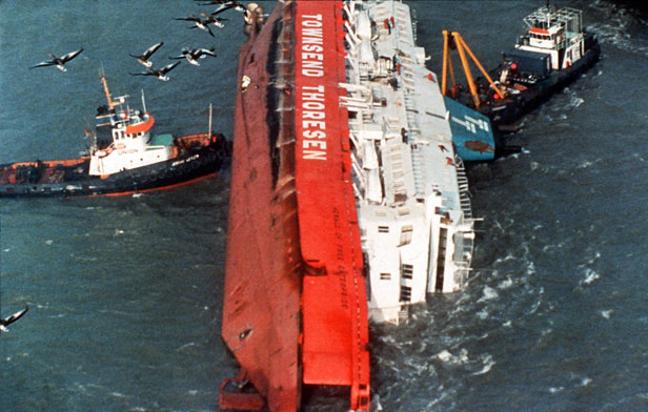
An Example from Reality
A vessel that sinks due to a flooded car deck subcomes within minutes, as the example below clearly shows. In March of 1987 the ferry M/V Herald of Free Enterprise left port with its bow doors open, thus exposing the vehicle deck to the sea. The consequences were immediate and catastrophic, the ferry rapidly gained a severe list and subsequently capsized. The whole event was over within a few minutes. Since the casualty occured in shallow waters, the ferry came to rest on its side with part of the superstructure above the waterline. This probably being the reason there were any survivors whatsoever.
The Case of the M/V Estonia
According to the official narrative the Estonia was subjected to a similar situation, having lost its bow visor, which in turn is supposed to have ripped the forward ramp to a wide open position, thus exposing the vessel’s car deck to the open sea.
Here the huge problem with that explanation arises, since Estonia remained afloat long enough for passengers to reach safety. There evidently even was time to deploy rescue equipment, which is a time consuming endeavour, to say the least. Survivors estimate the process of sinking lasted up to one hour.
The point here being the official chain of events should have resulted in a swift capsizing of the vessel, but clearly, this did not occur. This is furthermore emphasized by the fact that people residing in the lower departments of the vessel managed, despite all, to reach safety on the upper decks.
Conclusions
It is both clear and documented, from real examples, how a vessel behaves and subsequently sinks due to a flooded cargo deck. As the course of sinking regarding the M/V Estonia shows no sign of such, a complete and new review is needed to explain what really happened on that fateful last journey…
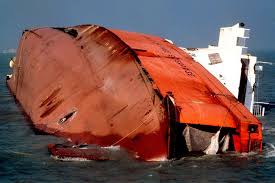
The M/V Herald of Free Enterprise
No responses yet